
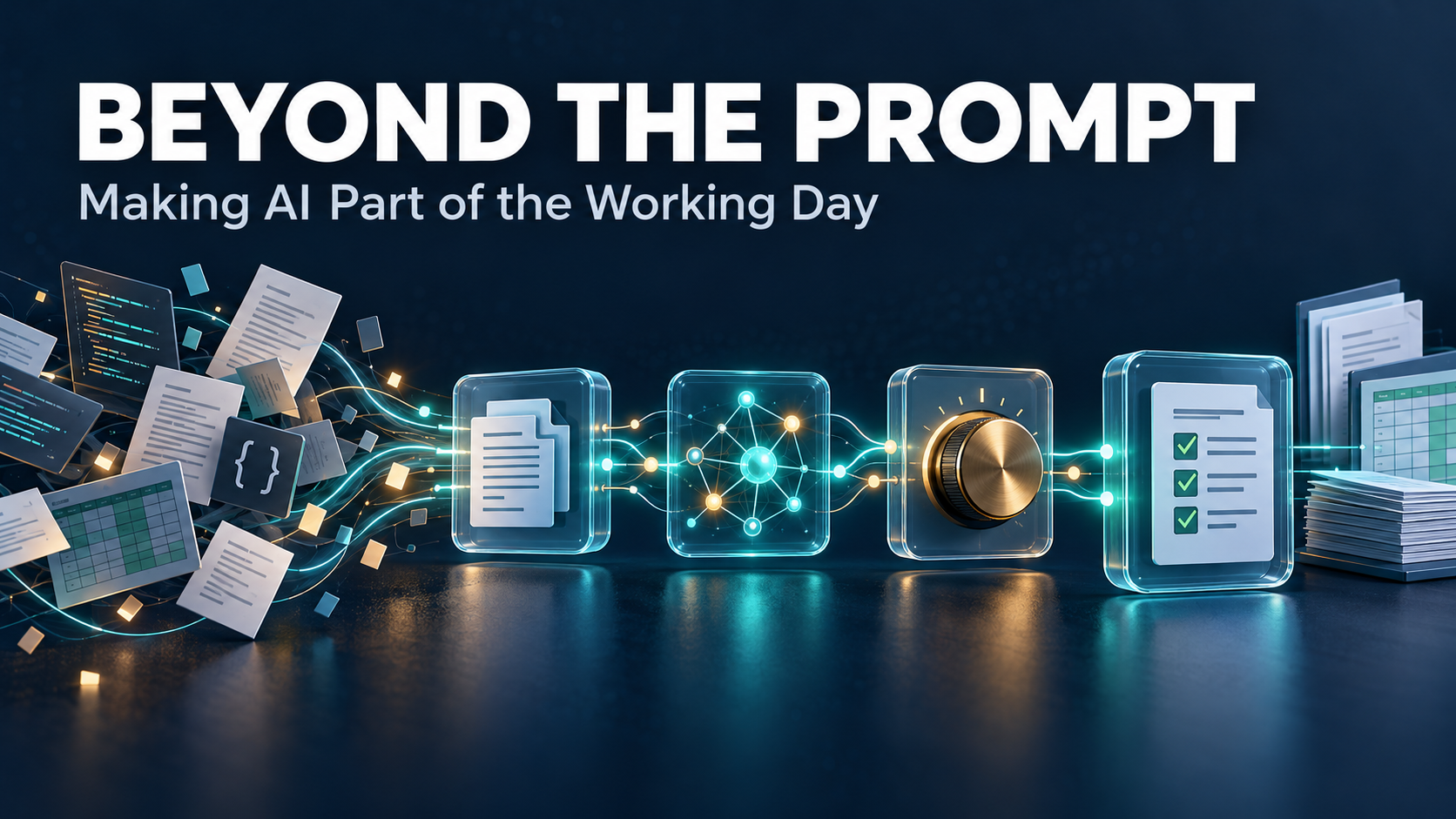
Over the past six weeks, I’ve spent more time using AI on the ordinary, complicated work that fills a working day.
Investigating problems. Improving existing software. Preparing documents. Bringing together information scattered across different places.
The work itself will sound familiar to anyone in a technical or operational role. There is usually something to understand, something to produce and something that needs checking before anyone can confidently move forward.
What has become clearer is how much the value of AI depends on the way that work is organised.
A useful conversation can solve an immediate problem. A repeatable process can make the next ten problems easier.
That is where my attention has been shifting.
Getting to the right question
A surprising amount of technical work happens before anyone makes a change.
There are logs to read, previous decisions to understand and differences between what people expected and what actually happened. Often, the information exists, but it is spread across several systems and conversations.
I’ve been using AI to help bring those pieces together.
For example, an investigation might start with an error message and an assumption about a recent upgrade. Reading the relevant code alongside the logs can reveal a more useful line of enquiry: how a process is being called, where a transaction begins or whether two operations can overlap.
That still needs investigation. A plausible explanation needs evidence.
The useful output is a clearer next step, with the supporting information attached. That gives me something I can test, discuss with a colleague or use to narrow the search.
It also makes “we don’t know yet” a more productive answer when it comes with a precise explanation of what remains uncertain.
Turning repeated work into a process
Some of the most practical work has involved documents and spreadsheets.
These tasks look straightforward until you list everything that needs to stay consistent: the source figures, calculation rules, rounding, wording, template, dates and tracking information.
An individual document can be produced quite quickly. Producing the next one correctly, then updating it when the underlying figures change, takes a little more thought.
I’ve been working through that distinction with AI: capturing the rules, applying an agreed template and checking that the outputs reconcile.
Every correction becomes useful information for the next run.
If a calculation needs rounding at a particular stage, that belongs in the process. If a revised worksheet should update an existing record, that needs to be explicit. If information is missing, the workflow needs to recognise the gap.
This applies well beyond commercial paperwork. Onboarding packs, project reports, support summaries and operational reviews all contain repeated decisions that are easy to leave undocumented.
Writing those decisions down makes them easier for both people and AI to follow.
Making improvements worth doing
I’ve also continued using AI to work on existing software, including tools I use myself.
There is a particular satisfaction in addressing a small frustration that has been sitting on the list for months. Understanding unfamiliar code, tracing a setting or working through a build problem becomes more manageable when there is help available throughout the task.
The full job still matters.
A change may need documentation, a build, relevant tests and a check that the resulting behaviour actually works. Sometimes the code looks reasonable and the application still exposes a problem that only becomes obvious when it runs.
AI makes more of these improvements practical to attempt. Completing them still requires attention to the result.
That has influenced how I ask for help. I increasingly describe the behaviour I need, the constraints around it and how we will know it works.
Keeping the useful knowledge
Across these different activities, the same questions keep appearing:
- What information should we start from?
- Which rules must remain consistent?
- What can be checked automatically?
- Where is human judgement needed?
- What should we retain for next time?
Answering those questions takes effort, but it reduces the amount of explaining and correcting needed later.
A good workflow carries forward the useful knowledge: an agreed template, a calculation rule, a diagnostic approach or a clear definition of completion.
It also makes the work easier to hand over. Another person should be able to understand how the result was produced and what still needs checking.
Being more deliberate about the outcome
In my earlier post about AI and management, I explored how AI could help create more room for leadership. Recent work has made me more conscious of the practical detail needed to achieve that.
A draft needs review. A proposed fix needs verification. A summary needs to preserve the difference between something reported, something attempted and something confirmed.
Those distinctions determine whether the output is useful.
My next step is to keep building on the processes that have proved useful, with clearer inputs, explicit rules and checks proportionate to the work.
There is plenty of excitement around what AI might eventually do. For now, I’m finding considerable value in making today’s work easier to understand, complete and repeat.
That feels like a worthwhile place to keep investing.